Tuesday, November 29, 2011


Saturday, November 19, 2011
Intel Shrinks Supercomputer Into the Palm of Your Hand

Intel's Technical Computing Group chief Raj Hazra holds a 1 teraflop Knights Corner chip.
Back in the late 1990s, Justin Rattner got a special sense of satisfaction every time he drove by a nondescript Intel building in Beaverton, Oregon. Inside, researchers from Intel and Sandia National Labs were assembling the ASCI Red supercomputer, the first computer capable of doing one trillion calculations per second.
That’s not bad for a chip that just a few years ago seemed to be a failure. Knights Corner was built from the ashes of Intel’s failed graphical processing unit (GPU), called Larrabee.
Nvidia has been making inroads with its Tesla processors.
When it goes online in January 2013, Stampede will have 10,000 times the processing power of ASCI Red
“It’s a reminder of how fast this industry moves,” he says. “I spent a lot of my life with a lot of my co-workers designing ASCI Red … to think that I can hold that in my hand now, it’s humbling.”.
How Many Neutrinos Does It Take to Screw Up Einstein?

Results from a second experiment uphold the observation that neutrinos are moving faster than the speed of light. The OPERA collaboration, which first reported the superluminal neutrinos in September, has rerun the experiment and detected 20 new neutrinos breaking Einstein’s theoretical limit.
The findings are heartening to anyone hoping to see a major physics revolution in their lifetime. But scientists, as ever, are being cautious, and it will take an independent replication of the results by another team to even begin convincing many of them.
But a great deal of scrutiny remains.
“I can now say that the probability of the result being correct has increased from 1 in a million to one in 100 thousand,” wrote physicist Philip Gibbs on the viXra log (though he stressed that those numbers were merely illustrative and not actual calculated values).
Tommaso Dorigo, a physicist at CERN, noted on his blog that there are still other possible sources of error. For instance, the OPERA collaboration’s clock might not have a fine enough resolution to determine exactly when the neutrinos arrived. “The measurement therefore is only a ‘partial’ confirmation of the earlier result: It is consistent with it, but could be just as wrong as the other,” he wrote.
Ultimately, the only thing that would convince many in the field is if another team upholds the findings in an independent experiment. Plunkett, co-spokesperson for the Main Injector Neutrino Oscillation Search (MINOS) experiment at Fermilab, says that his collaboration expects to have results checking the OPERA findings in the spring of 2012.
Image: OPERA collaboration
Saturday, October 22, 2011
Microsoft Talks Portrait Mode For Windows 8!

But there’s an wrinkle on tablet systems that has to be addressed that rarely, if ever, comes up on laptops: orientation. While very few people use their display in portrait mode, it’s extremely common to do so on tablets. Many apps and webpages work better when displayed vertically. So far, so normal for a tablet interface, but it must be just a little demoralizing to be working on something that a majority of users will never once encounter. Still, it must be done and they seem to be doing it well.
The stylized look of the Metro interface means it’s no small task to redo some apps, but they understand the usage scenarios and make things work. I like that things are optimized for thumb work in portrait mode, since it’s more likely you’ll be holding it with both hands in that situation (as opposed to it sitting in a stand or on a table, when it is more likely to be in landscape).

But I don’t really agree with this sentiment here:
Toshiba Shows Mobile LCD With 2,560 × 1,600 Resolution And 498PPI Density

Needless to say, the direct-view-type screen is the first of its kind. It has a contrast ratio of 1,000:1, displays 16.7 million colors and offers a 176° viewing angle (horizontally and vertically).
Here’s how a set of Japanese characters looks like with different PPI:
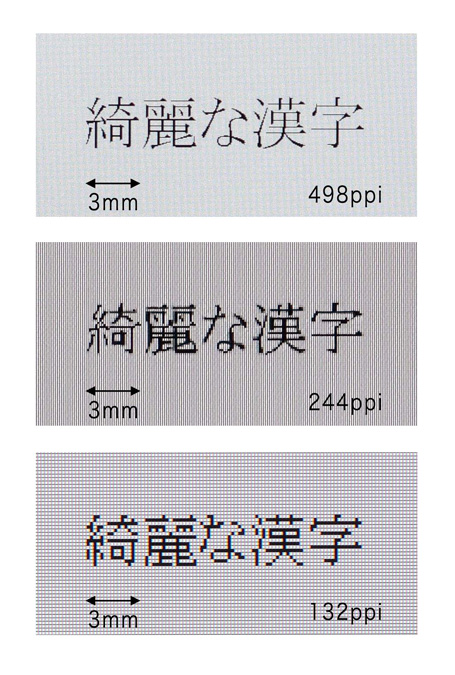 Toshiba plans to showcase the LCD next week at the FPD International 2011 exhibition in Yokohama, Japan.
Wednesday, October 19, 2011
Back Up Your Data on a Mac!!!!!!!!!

Hard drives fail, it's a fact of life. When yours does, unless you have a backup, you'll find yourself facing expensive data recovery services or worse: lost data.
Ideally, your backup system should be redundant. In other words, create at least two backups on two forms of media. At the very least, you should have a clone of your hard drive handy should your primary system go south.
Check out Cheap Android Tablet tries to out-cool the Fire
- Velocity Micro Cruz T408 and T410
- Tablets & E-Book Readers
- · $200 (8-inch), $300 (10-inch)
- · Velocity Micro

The battle over the mainstream tablet market all but over, smart competitors are turning to a familiar tactic to attempt to compete with the iPad juggernaut: Slashing prices.
Velocity Micro — a brand better known for its ultra-pricey, high-end gaming rigs — is getting there. Its first tablet product, the 7-inch Cruz T301, was met with general disdain, and VM went back to the drawing board to upgrade its offerings. The Cruz T408 (8-inch) and T410 (10-inch) tablets are more grown-up.
VM also throws in a few preinstalled apps, namely Angry Birds and the full version of QuickOffice, for whatever business users might snap up a Cruz.
Subscribe to:
Posts (Atom)